

As a leading provider of Aluminium Window Malaysia, we specialize in custom Aluminium frame windows & doors designed to cater to various architectural configurations. Our systems integrate high-performance thermal insulation, extreme durability, and sleek aesthetics. We are renowned for record-breaking installations, such as our 7.3m (H) x 1.48m (W) pivot door in Malaysia, and we collaborate closely with architects to fulfill complex, bespoke design requirements.
Can you tell me about the hardware and fittings you use? How do you ensure they last?While a standard Aluminium Sliding Malaysia system glides directly on a track—creating friction and potential wear—our Slim Frame Lift & Slide Door uses a specialized "lift" mechanism. This allows even the heaviest panels to operate effortlessly while providing a superior weather seal when closed. Considered a luxury sliding door, the Lift and Slide system offers better security via multi-point locking and requires significantly less maintenance because the rollers are not constantly under pressure against the track.
We use premium, fully imported European hardware for all our installations. These high-quality components are engineered to handle the substantial weight of large-scale glass, such as those found in a custom tall folding door. To give our clients peace of mind, our hardware comes with a 10-year manufacturer warranty, ensuring long-term loadbearing reliability and smooth performance for every customize aluminium product we deliver.
As a premier window & door supplier Malaysia, we provide a 10-year warranty for local projects and a 5-year warranty for overseas projects. In the event of a service request, our dedicated technical team maintains an average response time of 2 to 3 working days for local sites, ensuring your home remains secure and functional.
Every customize aluminium product we offer is based on profiles custom-designed by our in-house R&D team to meet specific performance and aesthetic standards. The extrusion process is carried out locally in Malaysia, allowing us to maintain strict quality control while supporting local manufacturing and ensuring the structural integrity of our frames.
Safety glass is specially manufactured to reduce injury risk when broken — it either breaks into small, blunt fragments or stays held together instead of shattering into sharp, dangerous pieces. The main standard types are:
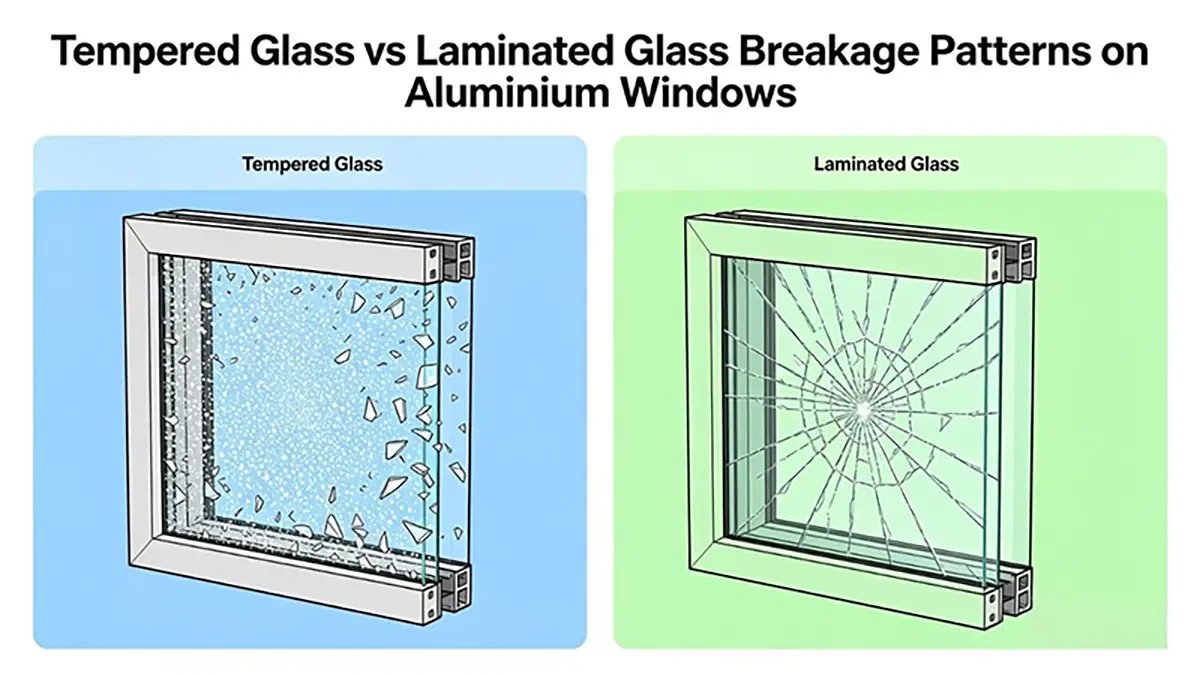
Toughened (Tempered) Glass — Breakage Pattern
- Breaks instantly into many small, blunt, cube-like granules.
- No large or sharp shards; greatly reduces risk of deep cuts.
- Fragments separate and fall out; pane loses shape completely.
Laminated Glass — Breakage Pattern
- Cracks in a distinct spider-web / radial pattern.
- All pieces stay firmly stuck to the clear internal plastic interlayer.
- Does not fall apart or scatter; pane remains in place as a barrier.
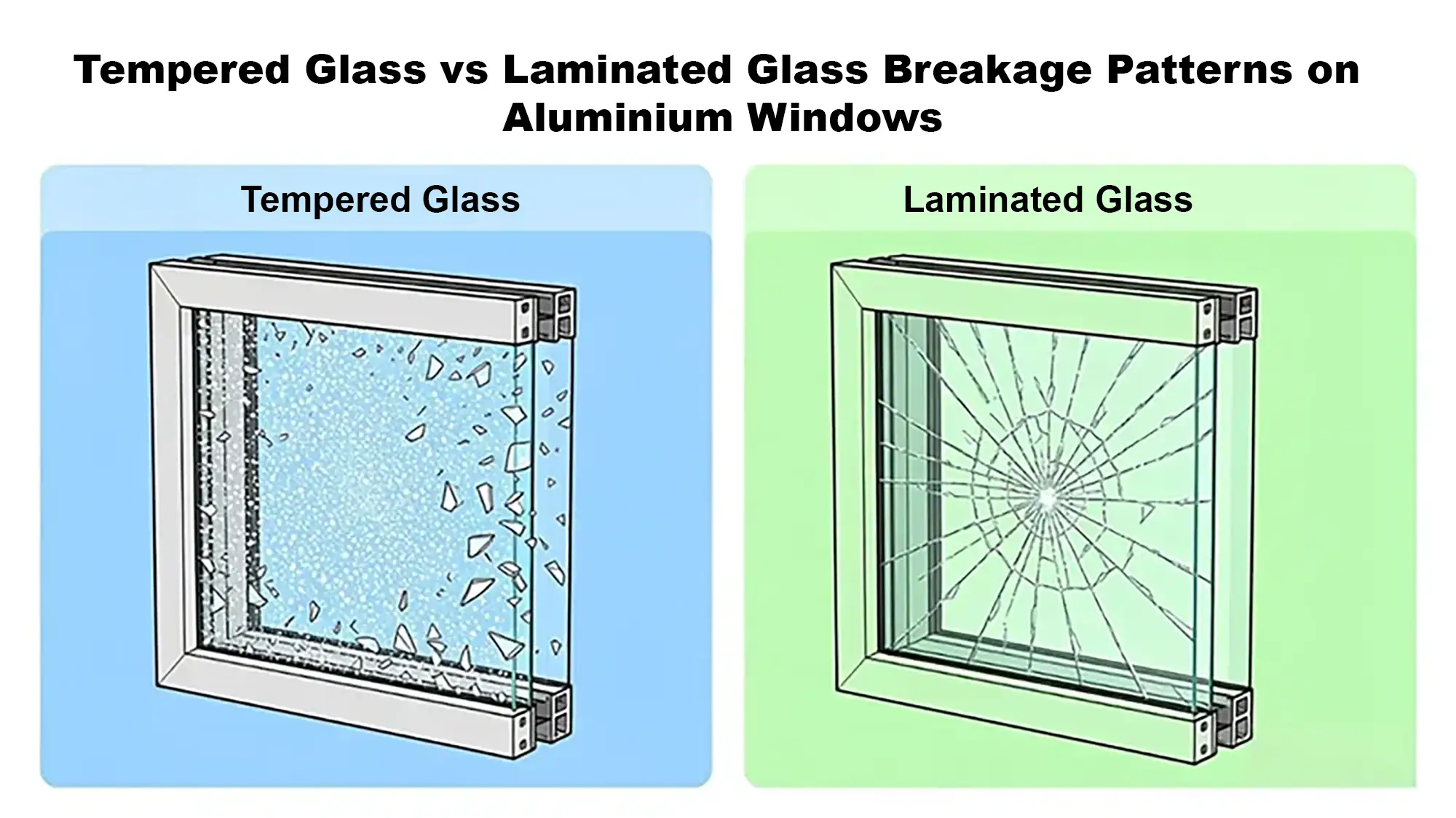
- Breaks instantly into many small, blunt, cube-like granules.
- No large or sharp shards; greatly reduces risk of deep cuts.
- Fragments separate and fall out; pane loses shape completely.
- Cracks in a distinct spider-web / radial pattern.
- All pieces stay firmly stuck to the clear internal plastic interlayer.
- Does not fall apart or scatter; pane remains in place as a barrier.
For private homes, these are the most commonly recommended glass types:
- Toughened Glass: Standard choice for windows, doors, balconies, and shower areas — meets safety requirements and offers good durability.
- Laminated Glass: Used for high-level windows, ground-floor openings, or areas needing extra security, noise reduction, or protection against falling glass.
- Float / Annealed Glass: Regular basic glass; only used in low-risk, non-safety locations, as it breaks into sharp shards.
- Insulated Glass Units (Double/Triple Glazing): Two or more panes sealed with air/gas between them; best for thermal insulation, energy efficiency, and soundproofing.
- Low-E Glass: Coated to reflect heat; often combined with toughened or laminated glass to keep homes cool in tropical climates and reduce energy use.
Below are the most widely used window opening types in residential projects, each with distinct features:
- Casement Windows: Hinged at the side, opens inward or outward like a door; gives full opening, excellent airflow, and good weather sealing.
- Sliding Windows: Moves horizontally along tracks; space-saving, easy to operate, ideal for areas with limited outdoor space.
- Top Hung Windows: Hinged at the top, opens outward/inward from the bottom; controlled ventilation, keeps rain out, safe for high floors and bathrooms.
- Tilt-and-Turn Windows: Dual function — tilts inward from top for ventilation, or swings fully inward for easy cleaning.
- Fixed Windows: Non-opening; used only for light and views, often paired with operable windows.
- Pivot Windows: Rotates around central axis; modern look, full airflow, suitable for large openings.